
You have a product to ship and a runway to protect. Every hour you spend writing tweets is an hour you did not spend on code, support, or sales calls. Yet without an audience, even the best product launches into silence. This is the core tension every indie hacker feels: grow on x twitter while building startup sounds like a second full-time job you never applied for.
It does not have to be. X is the natural home of indie hackers — founders share revenue graphs, launch announcements, and honest post-mortems there every single day. The platform rewards founders who show their work. And with the right system, you can turn one hour a week of writing into a month of consistent visibility. Your startup needs a distribution channel. This one runs while you code.
Why Founders Can’t Afford to Ignore X — and Can’t Afford the Time Either
Distribution is the part of building a startup that most technical founders skip. You polish the landing page, ship version after version, and then wonder why signups trickle in. The uncomfortable truth is that building in silence is a luxury founders cannot afford. X is where early adopters live — people who love trying new tools, who pay for beta software, and who amplify things they like to their own followers.
When you post about your journey, three things happen at once. First, you stay accountable, because an audience watching your progress makes quitting embarrassing. Second, you collect feedback from real users before you have built the wrong thing. Third, and most importantly, you are building a list of warm leads long before you need them. Launch day stops being a cold start and becomes a reunion with people who watched you build.
The problem is time. A founder’s calendar is already a battlefield: code reviews, bug fixes, customer support, and maybe sleep. Spending two hours a day scrolling, replying, and crafting posts is not realistic. The founders who seem to do it all are not working harder on social media — they are working on systems that do the heavy lifting. To grow on x twitter while building startup you do not need more hours. You need a repeatable process and a way to schedule the output so it posts while you are in the terminal.
How to Grow on X Twitter While Building Startup Without Burning Out
The build-in-public playbook looks chaotic from the outside — daily updates, milestone threads, replies everywhere. Underneath, it is a content system with three simple parts: capture, batch, and schedule.
Capture means collecting raw material as you work. Keep a running note — a plain text file, a notes app, whatever you already use — and drop in anything interesting: a bug that took three hours to fix, a support email that taught you something, a screenshot of a chart going up or down. You are not writing posts here. You are just logging reality. This takes minutes a day because you are already living the material.
Batch means turning those notes into posts once a week. Set aside one hour — Friday afternoon, Sunday morning, whatever works — and convert your notes into short posts. One lesson per post. One milestone per post. Do not aim for viral; aim for honest and specific. Specificity is what gets attention: “Fixed a caching bug that was costing us $180/month in server bills” beats “Keep shipping, founders!” every time.
Schedule means your posts go out on a consistent rhythm without you touching your phone. Draft your week’s posts in one sitting, load them into a scheduling queue, and let them publish while you are back to building. Consistency is the entire game on X — accounts that post five useful things a week outperform accounts that post thirty things one week and vanish for a month. For X (Twitter) this matters doubly because the algorithm rewards recency and consistency in replies and original posts alike.
This is where founders usually fall off. Manual scheduling inside the X app is tedious, and remembering to post breaks your flow. That is why many indie hackers use a desktop scheduling tool. AlcashX is a Windows desktop app built specifically for X automation: you write your posts in one batch session and it publishes them on your schedule, so your account stays active while you stay in the code editor. It costs $70/year ($50/6mo), which is less than one sponsored coffee for a week of consistent posting.
Scheduling Launch Updates, Milestones, and Lessons Learned
Not all posts are equal. The build-in-public content that actually converts followers into users falls into a few repeatable formats. Here is a simple weekly rotation you can steal:
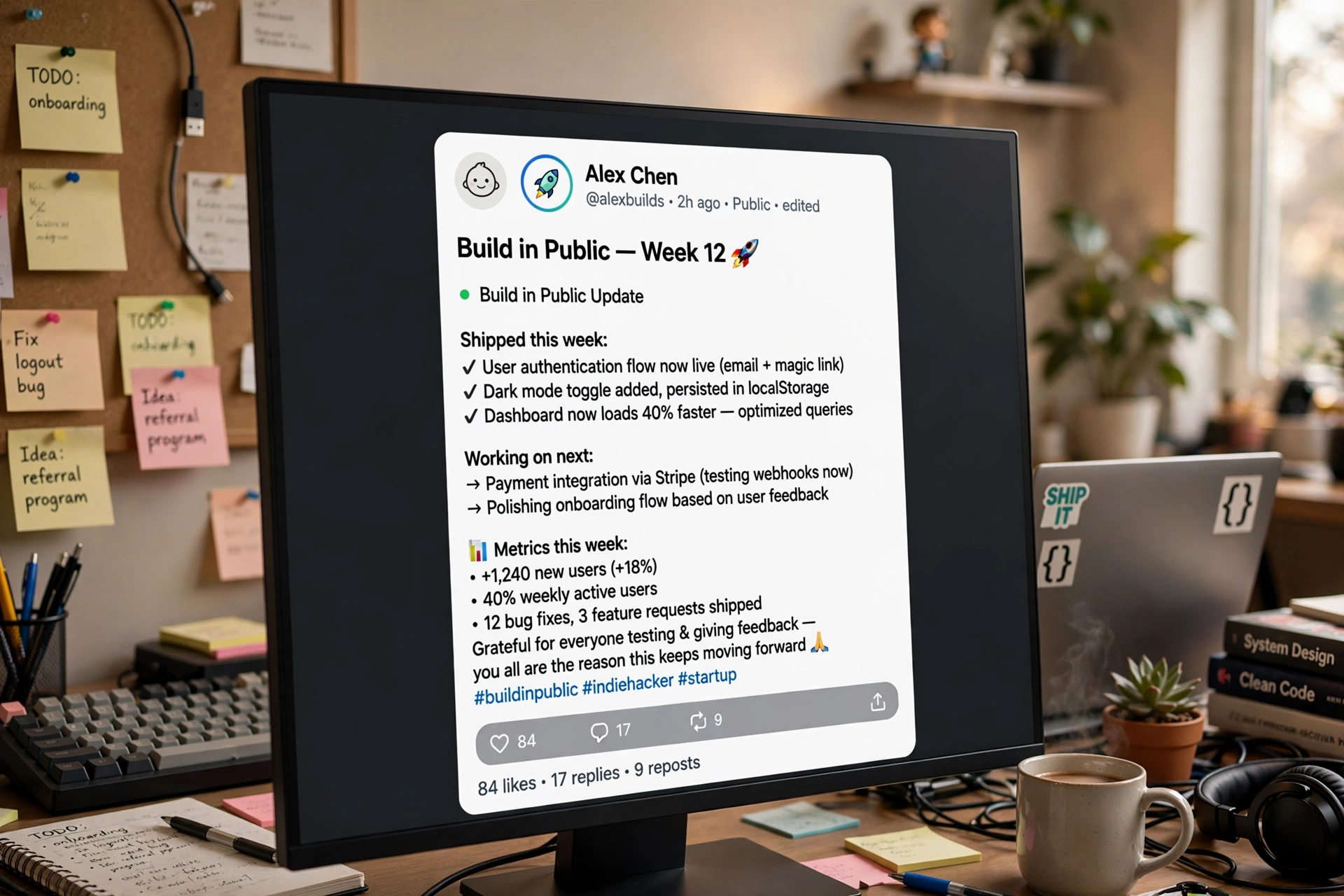
- Milestone Monday: share a number. Revenue, users, uptime, bugs fixed — any metric that moved. Numbers make abstract progress concrete, and concrete progress gets shared.
- Lesson Wednesday: share one thing you learned the hard way. A failed pricing experiment, a bad hire process, a support conversation that changed your roadmap. Vulnerability plus a lesson is the highest-trust content on the platform.
- Build Friday: show something you shipped. A screenshot, a short demo clip, a before-and-after of the UI. People follow building accounts to watch things get made — give them the behind-the-scenes view.
- Weekend thread: one longer thread per week. Your month in review, a how-to from your stack, or the full story of a launch. Threads compound — they get bookmarked, quoted, and discovered by search long after posting.
The secret is to write these in bulk. A two-hour writing block on Sunday can produce four weeks of Milestone Mondays and Lesson Wednesdays, because your daily capture notes already hold the raw material. You are not inventing content from scratch; you are formatting a diary you already kept.
And yes, schedule the launch itself. Launch day chaos means you will be fixing servers, answering emails, and refreshing dashboards — not crafting the perfect announcement. Write your launch posts a week ahead. Write the follow-ups too: the “here’s what broke in the first hour” post, the “here’s our first 100 signups” post. Pre-scheduling means your narrative goes out clean even when launch day is a fire.

Stay consistent on X without living on the app — automate posting, scheduling and account workflows from your desktop.
$70/year
Recycling Your Best Build-in-Public Posts
Here is a truth about X that new founders miss: almost nobody saw your best post. Even a post that did well reached a fraction of your current audience — and your audience keeps growing. A post that earned 200 likes when you had 500 followers deserves a second life now that you have 5,000. Recycling is not cheating. It is distribution.
Build a swipe file of your top posts. Once a quarter, review which posts earned the most replies, bookmarks, and profile clicks — not just likes, which are the shallowest metric. Those winners get three treatments:
- Repost with an update: quote your own old post and add what happened since. “6 months ago I shared our failed pricing test. Here’s what we changed, and revenue is up since.” This format performs absurdly well because it has a built-in story arc.
- Expand into a thread: a one-liner that resonated was probably a thread waiting to happen. Your audience already told you the topic works; now give them the full version.
- Flip the angle: a lesson from your perspective can become advice from your readers’ perspective. “How I fixed onboarding” becomes “3 onboarding mistakes that cost us our first 100 users.”
A practical note: if you repost manually, you need to remember which posts worked and when to reuse them. A scheduling tool that holds your content library makes this painless — you queue evergreen winners to recirculate every 60 to 90 days and they keep working while you ship features. For the full rundown of scheduling workflows and automation tactics, check the guides on the Alcashlabs blog, which covers content systems for founders and marketers.
Turning Followers Into Beta Users: The Auto-Plug Playbook
Followers are vanity; beta users are revenue. The bridge between them is a simple, repeatable call to action that you rotate through your content. The mistake founders make is pitching every post. The playbook is the opposite: give value in nine posts, plug in the tenth, and make the plug specific.
An effective auto-plug has three parts. First, it names the reader’s pain, not your product: “If you’re still posting to X manually between deploys…” Second, it names the outcome, not the features: “…here’s how I schedule a month of posts in one sitting.” Third, it gives one low-friction action: a reply, a DM, a link to the beta list. No one clicks “check out my startup” — but people reply to “reply BETA and I’ll send you the link.”
Pin your best plug. Your pinned post is free ad inventory that every profile visitor sees. Rotate it monthly: one month it is the beta signup, the next it is your best lesson thread, then back. And when someone does sign up, say thank you publicly — a quick “welcome to our first 50 beta users” post turns new users into ambassadors and gives your next hundred a reason to join.
One more conversion tactic that works quietly in the background: put your product in your name field and bio, not just your link. Your name shows up in every reply you make. “Alex — building @YourProduct” means every comment you leave on someone else’s thread is a tiny billboard. Engaging genuinely with other founders’ posts is free distribution, and your bio does the closing.

For a deeper look at how founders document their journey on video too, @alcashzone covers practical walkthroughs of growth workflows that pair well with a build-in-public strategy.
Ready to put your posting on autopilot?
Join the businesses already saving hours every week with AlcashX.
Or learn more first.
Frequently Asked Questions
How much time does it really take to grow on X Twitter while building a startup?
With a capture-batch-schedule system, about one to two hours a week: a few minutes of daily note-taking plus one writing batch. The founders who burn out are the ones posting manually in real time. Batch your writing, schedule your posts, and spend your remaining minutes only on genuine replies — replies are where relationships and beta users actually come from.
Is X still worth it for founders, or is the platform too crowded?
It is worth it because it is where your earliest adopters hang out. Yes, it is crowded — which is exactly why consistency and specificity win. Generic motivation posts drown. Specific build-in-public updates (numbers, screenshots, honest failures) still cut through because they are content only you can create. No one else can post your revenue graph.
Should I use my personal account or create a separate account for my startup?
Start with your personal account. People follow people, not logos, and build-in-public works because the founder is the narrator. Once the product has traction, you can add a company account — but in the early days, your face and name carry more trust than any brand account could.
What should I post when I have nothing impressive to share?
Post the un-impressive truth. Slow weeks, bugs, flat metrics, things you tried that flopped — this is the content other founders relate to most, and it builds the deepest trust. A founder who only posts wins looks like an ad. A founder who posts the full picture looks like someone worth following and buying from.
How do I schedule X posts so I can stay focused on building?
Write your posts in weekly batches and load them into a scheduling tool instead of posting live from the X app. Check the official guidance on post formatting and media at help.x.com so your scheduled posts render correctly, then let the queue publish on your rhythm. A desktop tool like AlcashX ($70/year, $50/6mo) handles the publishing for you, so your account stays consistent while you stay in the code.
— Team Alcashlabs