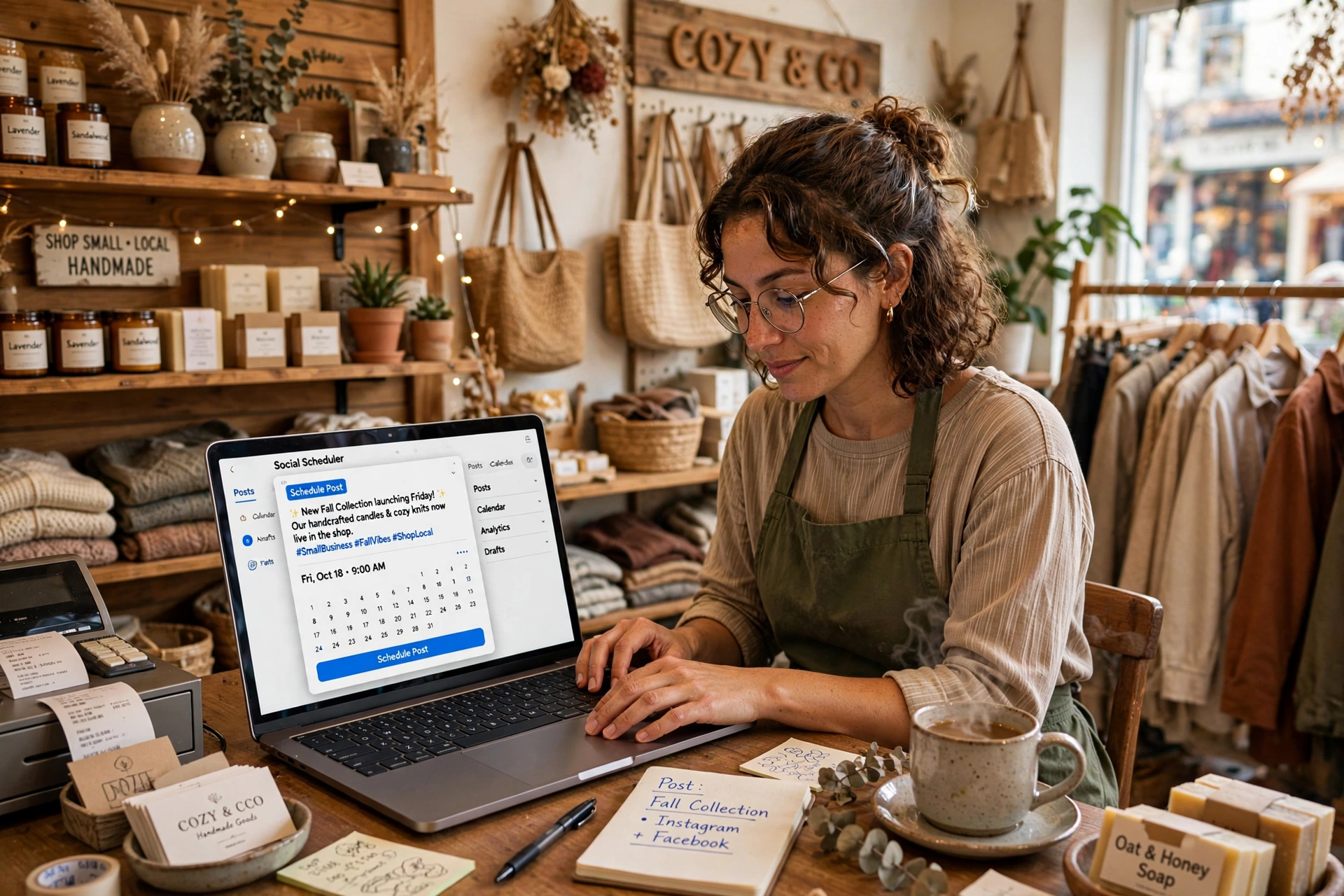
If you run a shop, you already wear every hat in the building. You open the shutters, you stock the shelves, you handle the customers, you do the accounts — and somewhere in between, you are supposed to be a content creator too. That is why so many owners give up on facebook instagram marketing for small shop businesses after three weeks of posting and getting five likes.
Here is the truth I want you to hear first: you don’t need a marketing department. You need 30 minutes and a system. Not an agency. Not a social media manager. Not three hours of scrolling for ideas every evening. Thirty focused minutes, once a week, plus five tiny minutes a day.
In this guide, I will walk you through the exact weekly system that lets retail shops, salons, cafés, bakeries, and food businesses stay visible on Facebook and Instagram without it taking over their lives. We will cover why most shops quit (and why it was never laziness), the 30-minute shoot-write-schedule routine, real content ideas that work for local businesses, how to schedule a whole week of posts and reels in one sitting, and the five-minute daily habit that keeps your accounts warm on the days you are not posting.
1. The Real Reason Shops Abandon Social Media (It’s Not Laziness)
Every failed attempt at facebook instagram marketing for small shop owners follows the same pattern. Week one: you post three times, full of energy. Week two: you post twice, and nobody responds. Week three: the shop gets busy, you miss two days, the guilt kicks in, and you quietly stop. The page sits dead for months. When someone finally asks, you say you were too busy.
But busy was never the real problem. The real problem is that you were running facebook instagram marketing for small shop pages on motivation instead of on a system. Motivation needs a decision every single time: What should I post? When? What photo? What caption? Every one of those decisions costs mental energy, and by evening you have none left. So you post nothing.
There is a second, sneakier problem: perfectionism. You see big brands posting polished videos and think your quick phone photo is not good enough. But customers of a local shop do not want a brand film. They want to see today’s fresh stock, the new haircut you just finished, the cake that came out of the oven this morning. Authentic beats polished every single time for a neighborhood business — and that authenticity is the biggest natural advantage you have in facebook instagram marketing for small shop niches.
The third reason is the cruelest: invisible progress. Social media growth for a small local business is slow at first, and you judge yourself against viral numbers. Here is an honest expectation: if your weekly posts consistently reach a few hundred local people who actually walk past your shop, that is real marketing. The goal of facebook instagram marketing for small shop businesses is not going viral — it is being remembered by the street you serve.
So forget motivation and forget perfection. What follows is a system that removes almost every decision. You will batch the work into one short weekly session, and the rest of the week runs on rails.
2. The 30-Minute Weekly System for Facebook Instagram Marketing for Small Shop Owners
The whole system has three blocks of ten minutes each. Pick one fixed day and time — Sunday evening, Monday before opening, whatever suits you — and treat it like a non-negotiable appointment with your own business.
Minutes 1–10: Shoot. Take your phone and capture 8–12 photos and 2–3 short videos of whatever is real in your shop right now. New arrivals on the shelf. A regular’s fresh haircut (ask permission, keep it friendly). Your best-selling dish. The shopfront on a sunny morning. Don’t style it, don’t filter it — real is the point. Stand near a window for decent light, hold the phone steady, and move on. Ten minutes, twelve shots, done.
Minutes 11–20: Write. In facebook instagram marketing for small shop accounts, you need five captions for five posts — and here is the secret: captions do not need to be clever. They need to be useful or human. A simple formula works every week: what this is + who it is for + what to do next. “New cotton kurtis in stock — perfect for office wear. Sizes S to XL, PKR 1,850. Message us to reserve yours.” That took twenty seconds and it sells. Write all five in one go in your phone’s notes app. Use one or two local hashtags (your city, your market area) so nearby people can find you.
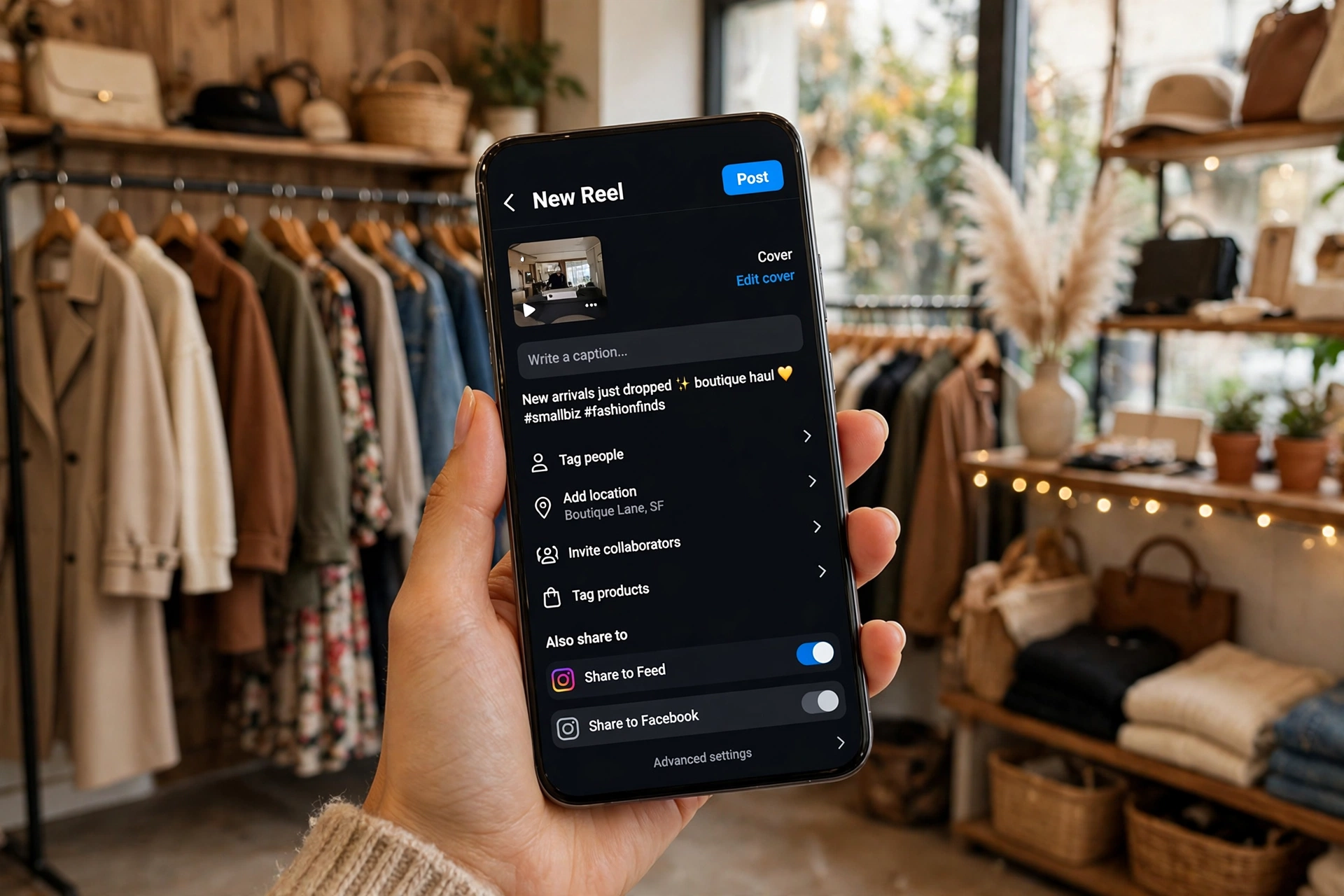
Minutes 21–30: Schedule. This is the step that changes everything. Instead of posting live every day — and forgetting half the time — you schedule all five posts (including a reel or two) in one sitting. Facebook and Instagram let you schedule ahead, and automation tools make it even smoother. You will learn the exact scheduling workflow in section 4 below. By the end of the thirty minutes, your whole week is queued and you do not have to think about it again until next week’s session.
That is the system. Shoot, write, schedule. No daily decisions, no guilt, no dead pages. Consistency is the entire game in facebook instagram marketing for small shop brands, and a system is what makes consistency possible. Once you have run this routine for three or four weeks, the whole rhythm of facebook instagram marketing for small shop pages starts to feel automatic — like locking the door at closing time.
3. Content Ideas That Work for Local Shops (With Examples)
The number one question shop owners ask: “But what do I post?” Here is the good news — local businesses have a bottomless well of content because their content is simply their real life. Here are formats that reliably work, with examples:
- New arrival announcements. “Just arrived: mango cheesecake slices, limited batch today.” Photograph it on the counter. This is the highest-performing post type for most food businesses.
- Before and after. Salons and tailors live on this. One photo of the customer before, one after the service. Permission and a smile included. (Illustrative example: a salon posts a 20-second reel of a haircut transformation — this format consistently earns saves and shares because viewers love the reveal.)
- Behind the counter. You kneading dough, unpacking a delivery, arranging the display. Customers love seeing the work behind what they buy — it builds trust money cannot buy.
- Customer favorites. “Our bestselling suit design this month.” Social proof in one line. Works for clothing, electronics, cosmetics — everything.
- Price and offer posts. Clear offers beat vague posts. “This weekend only: 10% off all kids’ shoes.” Put the deadline in the first line of the caption.
- The owner speaks. A 15-second video of you saying why you picked this product or how to use it. Your face is the most trusted brand asset your shop has.
- Questions and polls. “Which color should we stock next — navy or maroon?” Engagement costs you nothing and teaches you what to order.
Notice what none of these require: a camera crew, design skills, or a single rupee of ad budget. They require a phone, your shop, and ten minutes a week. If you ever feel stuck, scroll back through your own camera roll — the last month of shop life is a month of posts. For more practical walkthroughs like these, the tutorials on @alcashzone cover small-business marketing step by step.
4. Scheduling a Full Week of Facebook Instagram Marketing for Small Shop Posts and Reels in One Go
Scheduling is the engine that makes the 30-minute system real, and it is the step that separates successful facebook instagram marketing for small shop pages from abandoned ones. Here is how to do it properly so nothing slips through the cracks.
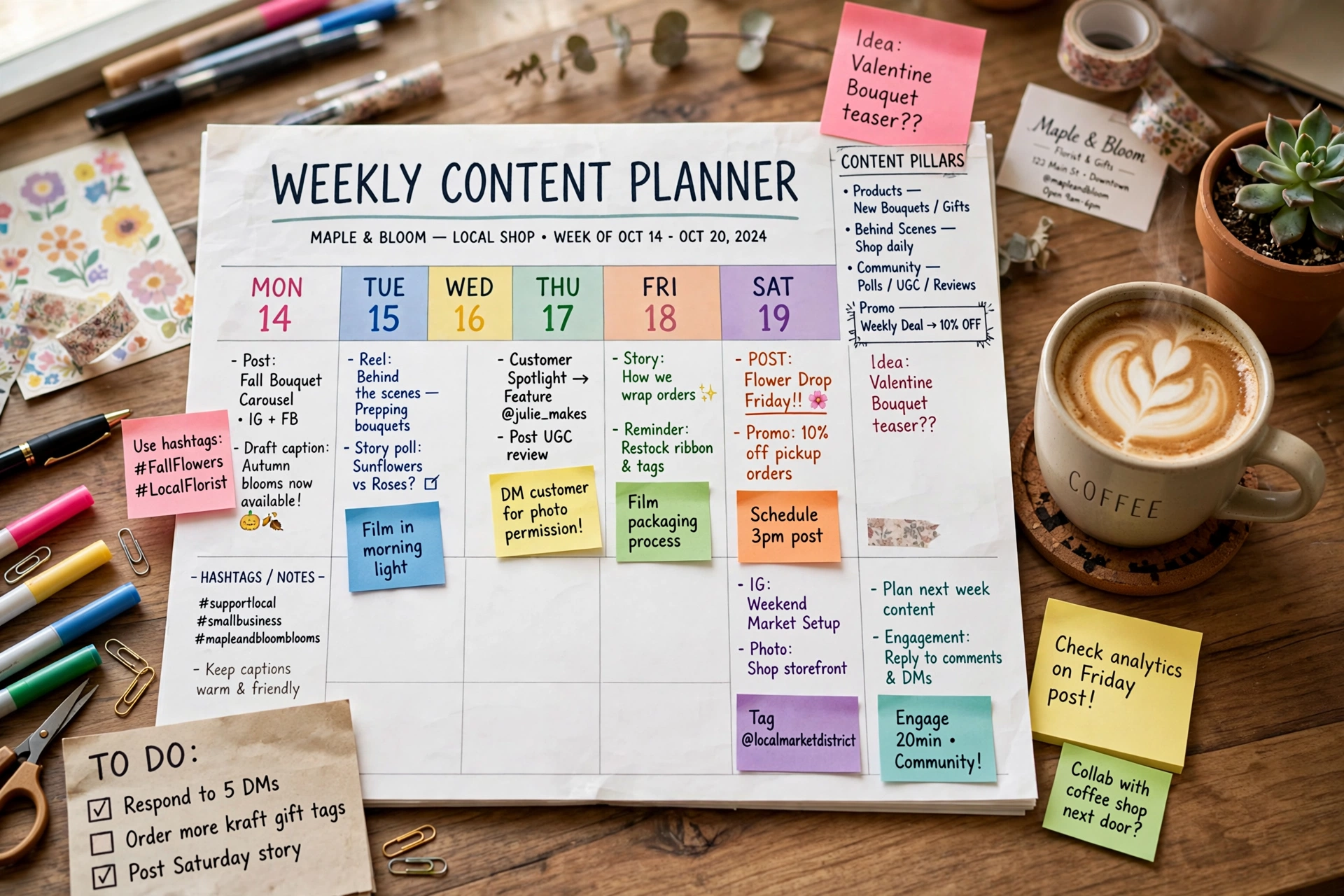
First, fix your weekly slots. For a shop, five posts a week is plenty: one on Monday morning (announce the week’s highlight), Wednesday and Friday (products or offers), and the weekend (behind-the-scenes or customer content). Keep the same slots each week so it becomes habit, not a decision.
Second, prepare your media and captions together. Rename your photos simply (monday-kurtis.jpg, friday-offer.jpg), and paste each caption into a note next to its file. This sounds fussy, but it saves you from the classic mistake of scheduling a photo with the wrong caption — or a caption with no photo.
Third, load them into a scheduler. You can schedule natively through Facebook’s tools, and Instagram’s official business guidance explains what business accounts can do — see Instagram’s business resources and the Facebook business help center for the platform’s own documentation on scheduling and business features.

The simplest, most affordable way to bulk-schedule posts, reels and stories — built for small businesses and tight budgets.
$40/year
But here is the friction every shop owner hits: native scheduling means jumping between two platforms, two interfaces, and two sets of rules — and the moment it feels complicated, you stop doing it. That is exactly why a simple automation tool earns its keep. FlowPost is built for this exact job: one Windows desktop app where you write your week’s Facebook posts and Instagram content once and schedule them all out, without touching two dashboards. It is the simplest and most affordable of Alcashlabs’ automation tools — $40/year + $10/mo — made for owners, not agencies. If your 30-minute system keeps dying at the scheduling step, that step is your bottleneck, and this removes it.
Finally, verify the queue. After scheduling, glance at the scheduled list: five posts, correct days, correct images. Two minutes of checking beats a week of embarrassment — and this small verification habit is a hallmark of disciplined facebook instagram marketing for small shop owners. If you want ideas for what the pros do with their scheduled content, the Alcashlabs blog has practical guides on social media automation for small businesses.
5. What to Do on the Days You’re NOT Posting (Engagement in 5 Min/Day)
Here is what most guides never tell you: posting is only half of facebook instagram marketing for small shop success. The other half is showing up for five minutes a day. The algorithm notices accounts that engage, and — more importantly — your customers notice too.
Set a five-minute timer once a day, ideally when you are having tea. Do three things: reply to every comment and message on your posts (even a one-line thank-you counts — unanswered comments teach people not to comment), comment on two or three posts from nearby businesses or regular customers (genuine comments, not ads), and react or reply to anyone who tagged your shop or checked in.
That is it. Five minutes. Do not scroll. Do not open the explore tab. This is a business task, not entertainment. In facebook instagram marketing for small shop brands, owners who do this daily habit report something interesting (illustrative): a customer who gets a reply within the hour often walks in that same week, while an ignored comment fades into nothing. Reply speed is free customer service that happens to look like great social media.
One honest note: this five minutes matters more than adding a sixth post. An account with four posts and real replies always looks more alive than an account with seven posts and silence. In facebook instagram marketing for small shop pages, engagement is what turns followers into regulars — and regulars are what keep a shop open.
Ready to put your posting on autopilot?
Join the businesses already saving hours every week with FlowPost.
Or learn more first.
6. FAQ
How many times a week should a small shop post on Facebook and Instagram?
For most local shops, four to five posts a week is the sweet spot — enough to stay visible, not so many that you burn out. Consistency beats frequency: one steady month of five posts a week will outperform three frantic weeks of daily posting followed by silence.
Is it better to post the same content on Facebook and Instagram?
Mostly yes, with small tweaks. Your Facebook audience skews toward people who message you directly about products, while Instagram rewards short video and behind-the-scenes content. Use the same core photos and offers, but lead with a reel on Instagram and a clear text-first post on Facebook. Scheduling them together from one tool saves the duplicate work.
Do I need to pay for ads to make facebook instagram marketing for small shop pages work?
No — not at the start. Organic posting reaches your existing customers and nearby followers, which is exactly who buys from a shop. Once you have three months of consistent posting and you know which posts your customers love, you can put a small budget behind your best-performing offer posts. But the system in this guide works with zero ad spend.
What if I have no followers yet?
Start with people who already know you. Invite your existing customers: a small sign at the counter (“Follow us for weekly offers”) turns foot traffic into followers. Post consistently for two to three months, use local hashtags and your location tag on every post, and engage daily. Local growth is slower than viral growth, but every local follower is a potential customer — which is worth far more than a thousand distant ones.
Can I really run this in 30 minutes a week if I’m not tech-savvy?
Yes. The 30-minute system uses only your phone’s camera and a notes app for the first two steps. The scheduling step is the only part that benefits from a tool, and it is a simple desktop app: write once, schedule the week, done. If you can send a WhatsApp message, you can run this system.
— Team Alcashlabs